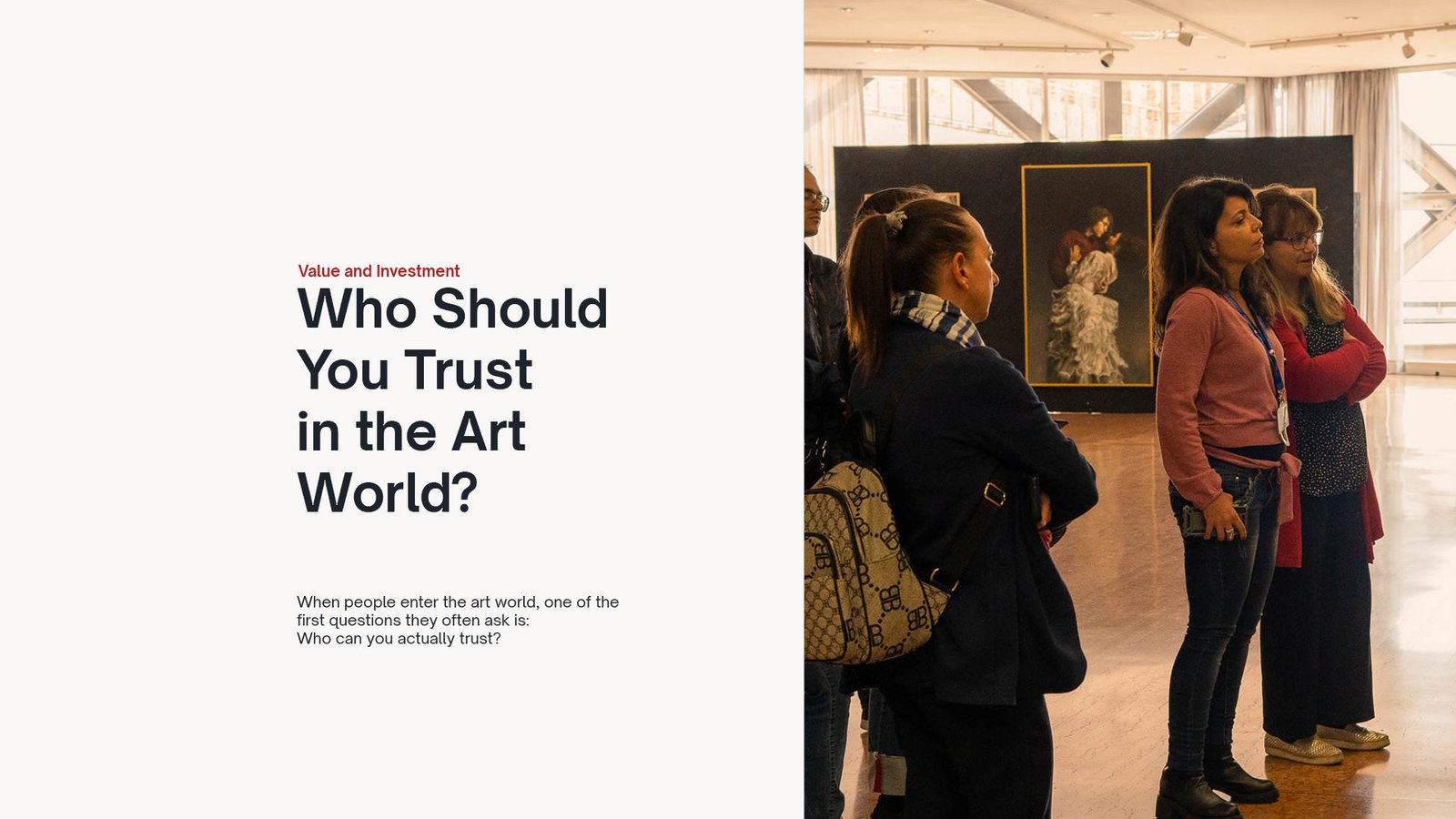
Who Should You Trust in the Art World?
How to Compare “Apples to Apples” in a World Full of Narratives
Galleries.
Auction houses.
Critics.
The market.
Social media.
Fame.
When people enter the art world, one of the first questions they often ask is:
Who can you actually trust?
Many people look for simple signals to navigate a world that feels complex, exclusive, and sometimes confusing.
Because of that, people often rely on mental shortcuts like:
“If an artist is represented by a big gallery, they must be valuable.”
“If an artwork is expensive, it must be important.”
“If an artist has a huge online following, they must be relevant.”
“If the work was sold at auction, then it must be a good investment.”
But the art world rarely works in such a simple way.
Every part of the system looks at art through different goals, interests, and perspectives. Galleries build careers. Auction houses create competition. Media platforms amplify cultural narratives. Social media rewards speed and instant attention.
This does not automatically mean that people are lying.
But it does mean that no single voice should completely replace your own judgment.
And this is where maybe the most important skill in the art world begins:
developing your own critical thinking.
Because in the art world there are many narratives.
But learning how to compare “apples to apples” is still one of the most valuable skills a person can build.
The Problem of “Who Is Right?”
Many people enter the art world looking for an absolute authority. A person or institution that can remove all doubt and give a simple answer to the hardest question of all:
“Does this art actually have value?”
The problem is that the art world does not work like an exact science. There is no single universal rule that can permanently define the quality, importance, or relevance of an artwork.
Because of this, many people end up relying on external signals:
“If the artist is in a major gallery, then the work must matter.”
“If it’s expensive, then it must be important.”
“If the artist is famous, then it must be great art.”
“If the work sold at auction, then it must be a good investment.”
These things can absolutely mean something. It would be naive to completely ignore them. But they become dangerous when people treat them like absolute proof.
A high price can sometimes come from speculation.
Strong media attention can be the result of good marketing and communication.
A major gallery may choose artists based on curatorial vision, market strategy, or positioning.
The point is not to reject these systems.
The point is to understand that every system looks at art from a specific perspective.
And when a perspective gets confused with absolute truth, people risk losing the ability to think and judge for themselves.
Every Player in the Art World Has Their Own Agenda
This does not automatically mean people are dishonest.
It simply means that different people and institutions have different interests.
One of the most common mistakes is imagining the art world as a completely neutral system. In reality, like any human ecosystem, it is made of individuals, institutions, and organizations that operate with different goals and motivations.
Understanding these dynamics is not about becoming cynical.
It is about learning to see the system more clearly.
The art world is influenced by business, culture, reputation, storytelling, personal taste, money, status, and long term strategy. Because of that, every part of the system naturally sees art through its own lens.
A gallery may focus on building an artist’s career.
An auction house may focus on market demand and competition.
A critic may focus on cultural relevance or intellectual ideas.
Social media platforms may reward what gets attention fastest.
None of these perspectives are automatically wrong.
But problems begin when people mistake one perspective for the complete truth.
Galleries
Galleries play a fundamental role in the art world. They help build artists’ careers, introduce artists to the market, and create relationships with collectors, curators, and institutions.
But a gallery is not a neutral observer.
A gallery has a natural interest in promoting the artists it represents, building their reputation, and increasing the public perception of their value over time.
This is not necessarily a bad thing. In fact, it is part of the gallery’s role.
Strong galleries often invest years supporting artists through exhibitions, networking, marketing, art fairs, and long term career development.
The problem begins when people automatically assume that being represented by a gallery is absolute proof of artistic importance.
A gallery can absolutely help validate an artist’s position in the market. But galleries also make choices based on business strategy, audience, branding, trends, and curatorial direction.
Being in a gallery can mean something important.
But it should not replace personal judgment and critical thinking.
Auction Houses
Auction houses operate in a different way. Their system is heavily based on public competition and the perception of economic value.
Auctions can create excitement, urgency, and strong media attention. Some auction results become symbolic and help shape the public narrative around an artist.
But an auction price does not automatically equal cultural or historical importance.
The market can be influenced by speculation, scarcity, temporary trends, or acquisition strategies.
There are culturally important artists who never reached spectacular auction prices. And there are artists with a very strong market who may not leave a lasting historical impact.
Critics and Media
Critics, journalists, and cultural media have enormous influence in shaping public opinion in the art world.
They can help introduce new artistic movements, give visibility to emerging artists, and create important cultural conversations.
But media platforms also follow specific dynamics:
attention, relevance, storytelling, and cultural trends.
Some artists become extremely visible because they perfectly represent a certain historical moment or social conversation.
However, this does not automatically mean that every media phenomenon is destined to remain important in art history.
Social Media
Social media has radically changed the way people experience and consume art.
Today, an artist can reach millions of people without going through galleries or traditional institutions.
This has democratized many parts of the art world. But it has also introduced new distortions.
Platforms tend to reward:
- speed,
- instant reactions,
- easily consumable content,
- and images that create immediate impact within the first few seconds.
But virality and depth are not necessarily the same thing.
An artwork can perform extremely well online while having very little conceptual complexity or physical presence in real life. On the other hand, some artworks that feel incredibly powerful in person may appear almost invisible on social media.
Collectors
Collectors also have very different motivations from one another.
Some buy art purely because they love it.
Others are interested in social status.
Some see art as a financial asset.
Others want to leave behind a cultural legacy.
None of these motivations are automatically “right” or “wrong.”
But understanding the intentions behind certain decisions can help people better understand how the art world really works as a whole.
The Problem of Comparing Apples to Oranges
One of the most common mistakes in the art world is comparing artists using completely different standards.
Many discussions become confusing because people place very different types of value on the same level, even when they belong to completely different categories.
For example:
- followers versus technical skill,
- price versus cultural impact,
- hype versus long term consistency,
- decoration versus artistic research,
- local fame versus international relevance.
These comparisons often do not work because they are measuring different things.
An artist can be incredibly skilled technically but have little cultural relevance.
Another artist may have huge cultural impact while using a very simple visual language.
And another may have a strong market without bringing much artistic innovation.
This is why one of the most important steps is defining the criteria of the comparison.
Are we talking about:
- technical quality?
- historical impact?
- storytelling and narrative?
- economic value?
- innovation?
- cultural influence?
- decorative function?
- brand recognition?
If the criteria are not clear, the discussion quickly becomes chaotic.
Learning how to compare “apples to apples” means learning how to build coherent comparisons instead of mixing completely different standards together.
What Does “Value” Really Mean in Art?
One of the most commonly used words in the art world is “value.”
But people rarely stop to ask what that word actually means.
The reality is that there are many different types of value in art, and they are often confused with one another.
An artwork can have economic value, cultural value, historical value, emotional value, symbolic value, or even purely decorative value. Sometimes these overlap. Sometimes they do not.
This is one of the reasons why conversations about art can become so confusing. People may be using the same word while talking about completely different things.
Economic Value
This is the type of value created by the market:
prices, sales, demand, and scarcity.
It is the most visible form of value because it can easily be measured with numbers.
Cultural Value
This refers to the ability of an artwork to influence conversations, culture, and the way people think or create.
It does not always match the market value of the work.
Historical Value
Some artworks become important because they represent a historical moment, a social change, or an important artistic breakthrough.
Emotional Value
Many people buy art not as an investment, but because they feel a strong personal connection to it.
An artwork can have deep meaning in someone’s life even without market success or institutional recognition.
Symbolic Value
Art can become a symbol of identity, belonging, status, or a way of seeing the world.
Decorative Value
Not all art is created to change culture or art history. Some artworks mainly exist to create beauty, atmosphere, or harmony inside a space.
Speculative Value
Sometimes art is purchased mainly because people believe its financial value may increase in the future.
The important thing to understand is that these different forms of value do not always overlap.
An artwork can have huge cultural impact while having a small market.
Or it can have a very strong market while leaving little historical impact.
Confusing these different types of value creates a lot of misunderstanding in the art world.
The Most Important Skill: Developing Critical Thinking
Maybe the real answer to the question “Who should you trust?” is this:
do not completely outsource your judgment to someone else.
Developing critical thinking takes time. There is no instant shortcut.
It means:
- looking at a lot of art,
- visiting exhibitions,
- studying art history,
- understanding how the market works,
- learning to distinguish technique, visual language, and narrative,
- and understanding the cultural context in which an artwork is created.
But most importantly, it means learning how to make coherent comparisons.
Many people are looking for someone to tell them what to think.
But over time, a real collector develops their own sensitivity. A personal ability to observe beyond commercial narratives and media attention.
And in the long run, it is exactly this sensitivity that allows someone to build a deeper and more conscious relationship with art.
The Paradox of the Art World
There is an interesting paradox in the art world.
Many people look for absolute certainty in a field that is deeply connected to interpretation.
Art is not mathematics.
There is no perfect algorithm that can permanently decide what has value and what does not.
Public opinion changes over time.
Some artists are ignored for decades and later become incredibly important. Others are celebrated during their lifetime but slowly disappear from cultural memory.
This happens because artistic value is also shaped by cultural sensitivity, and culture is constantly evolving.
And maybe this is one of the most fascinating aspects of art:
its inability to be completely reduced to fixed formulas and absolute certainty.
Doubt is not a flaw in the process.
It is part of the process itself.
Conclusion
Maybe the real question is not: “Who should I trust?”
But rather: “Am I developing enough sensitivity to build my own judgment?”
Because the art world is full of narratives.
Different strategies.
Different interests.
Different systems of validation.
But taste, understanding, and critical thinking are still some of the few things that cannot be completely outsourced to someone else.
And maybe that is exactly where the most authentic relationship with art truly begins.
